

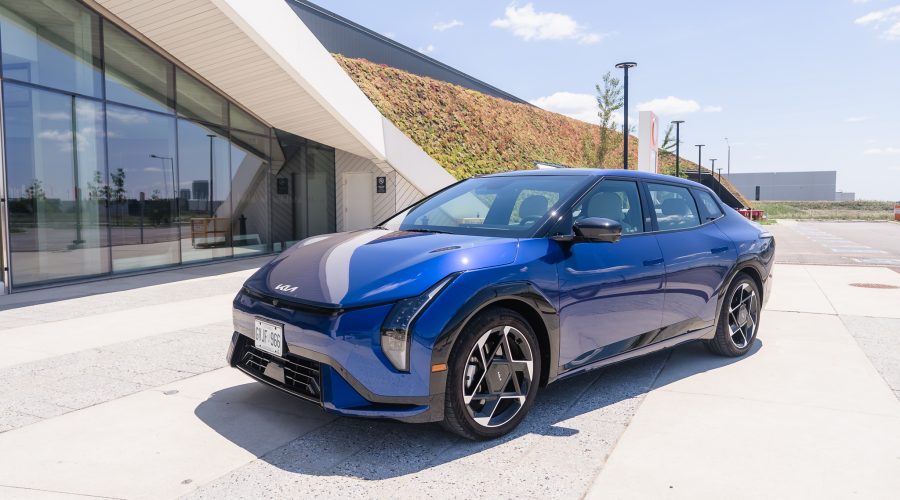
2026 Kia EV4 Review
SUVs and crossovers have taken over Canadian driveways to such an extent that launching an all-new four-door sedan in 2026 almost feels rebellious.
Launching an electric sedan?
Now you’re just looking for trouble.
Lorem ipsum dolor sit amet, consectetur adipiscing elit. Ut elit tellus, luct
And yet, after spending some time with the new 2026 Kia EV4 GT-Line FWD, I’m wondering whether Kia might be onto something.
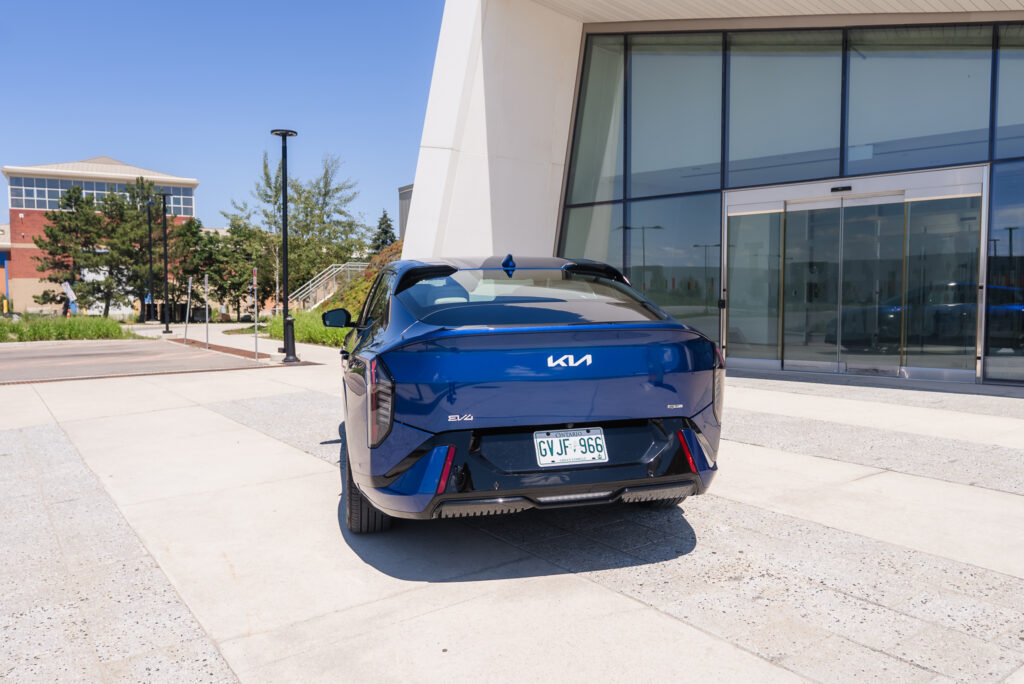
The EV4 is modern, slick and genuinely cool-looking, but thankfully it doesn’t suffer from the “LOOK AT ME, I’M ELECTRIC!” design philosophy that afflicted some of the industry’s earlier EVs. There are certainly futuristic touches, but fundamentally it’s just a really attractive four-door car.
And more importantly, it drives really well.
Let’s Start With The Money
Our GT-Line FWD tester carries an MSRP of $48,495, which is an extremely important number because Canada’s new Electric Vehicle Affordability Program offers up to $5,000 toward eligible battery-electric vehicles with a final transaction value of $50,000 or less.
Suddenly, $48,495 can effectively become $43,495 before taxes and applicable fees.
The EV4 lineup currently looks like this:
- Light FWD: $38,995
- Wind FWD: $42,995
- Wind Premium FWD: $45,495
- GT-Line FWD: $48,495
- GT-Line Limited FWD: $51,995
Thank you to CarCostCanada for the pricing information and there’s my first shameless but completely relevant corporate plug.
Here’s where things get interesting.
The first four trims currently qualify for the $5,000 federal incentive. The $51,995 GT-Line Limited doesn’t.
Therefore, the Limited isn’t really $3,500 more expensive than the GT-Line to the consumer.
It’s effectively $8,500 more.
Plus tax.
Ouch.
The Limited certainly adds some nice toys, but I’d have an extremely difficult time justifying another $8,500 to get them. In fact, the federal government’s $50,000 cutoff inadvertently makes the GT-Line one of the sweetest spots in the entire EV4 lineup.
Sometimes, government policy and automotive product planning accidentally produce something useful together.
Who knew?

This Doesn’t Feel Like A Cheap EV
One thing Kia has become exceptionally good at is making affordable vehicles feel expensive.
The EV4 continues that tradition.
The dashboard and infotainment system follow the familiar Kia format found throughout much of the company’s lineup, with a large panoramic display arrangement, attractive graphics and an interior that feels much more upscale than the price suggests.
That’s particularly impressive when you consider the entry-level EV4 Light.
Start with its $38,995 MSRP and subtract the $5,000 federal incentive, and you’re effectively looking at $33,995.
For perspective, a well-equipped gasoline-powered 2026 Kia K4 EX Premium is around the $30,000 mark.
Now we’re getting somewhere.
Even comparing the EV4 Light with the much less expensive entry-level K4 LX, the gap starts shrinking when you consider operating costs.
If you’re currently spending $80 a week on gasoline, that’s roughly $350 a month. Over 28 months you’ve fed approximately $9,700 into your fuel tank.
Electricity isn’t free, of course, but if you’re able to charge primarily at home, particularly overnight, the energy cost can be dramatically lower.
Suddenly that more expensive EV doesn’t look quite so expensive.
And Then You Drive It
This is where the EV4 really started winning me over.
Like virtually every modern EV, there’s instant torque the moment you press the accelerator. Kia’s front-mounted electric motor produces 201 horsepower, and while this isn’t intended to be some neck-snapping electric performance car, it certainly doesn’t feel slow.
Around town it’s smooth, quiet and effortless.
On the highway it’s even better.
Put your foot down to merge and the EV4 simply gets up and goes. There’s no transmission deciding which gear it would like, no engine suddenly screaming toward redline and no dramatic mechanical production taking place beneath the hood.
You ask for speed.
It provides speed.
Next question.
The EV4 also doesn’t give you that low-to-the-ground feeling that sometimes turns buyers away from sedans after years of driving SUVs and crossovers. Visibility is good, the seating position is comfortable, and the car feels planted and substantial.
Handling is predictable and confidence-inspiring, particularly at highway speeds, while around town its dimensions make it considerably easier to manoeuvre than the increasingly enormous SUVs populating Canadian parking lots.
Remember when parking a car didn’t require six cameras and an air-traffic controller?
I do.


488 Kilometres Changes The Conversation
Our GT-Line carries an 81.4-kWh battery and offers an estimated 488 kilometres of driving range.
That’s impressive.
The less expensive Wind FWD actually does even better, reaching an estimated 552 kilometres, while the Light’s smaller 58.3-kWh battery delivers 391 kilometres.
Range anxiety hasn’t disappeared, but numbers like these are certainly making the argument less relevant.
The EV4 also comes standard with the North American Charging Standard (NACS) port, and Kia says a DC fast charger can charge the larger battery from 10 to 80 percent in approximately 31 minutes.
So no, it’s still not as quick as filling a gasoline tank.
But we’re getting closer.

What Happens When The Battery Gets Old?
And now we arrive at the elephant quietly sitting in the back seat of virtually every EV discussion.
The battery.
Kia provides an excellent 5-year/100,000-km comprehensive warranty, while the EV system is covered for 8 years/150,000 km and the high-voltage battery receives 8-year/160,000-km capacity coverage.
That’s reassuring.
But consumers aren’t unreasonable for wondering what happens in year nine, ten or eleven if something expensive goes wrong.
A modern EV battery isn’t necessarily destined to suddenly “pooch” the day after its warranty expires, and degradation is different from outright battery failure. Packs can also sometimes be repaired at the module or component level rather than automatically requiring complete replacement.
Still, battery replacement costs remain one of the legitimate long-term questions surrounding used EV ownership.
Maybe instead of giving us $5,000 when the vehicle is brand new, the government should put the money into a little account labelled:
“DO NOT OPEN UNTIL 2034.”
I’m kidding.
Mostly.

Great Car. But Who Is Buying It?
This might be the most interesting question surrounding the EV4.
Logically, I would expect younger and more urban buyers, the same people shopping Honda Civic, Toyota Corolla, Mazda3, Nissan Sentra, Hyundai Elantra and Kia K4.
Notice something missing from that list?
There isn’t a domestic sedan anywhere to be found.
I asked one of our LeaseBusters dealer account managers to speak with one of his Greater Toronto Area Kia dealership partners about who’s actually buying EV4s.
The answer wasn’t particularly scientific because, frankly, the dealer hasn’t sold enough of them yet to establish a meaningful buyer profile. We’re talking perhaps a couple per month.
What he was emphatic about was the Kia EV5.
That’s the EV getting attention at his store.
And it’s not difficult to understand why. The EV5 Light FWD starts at $43,495, before the available federal incentive.
That creates a problem for the EV4.
Canadian consumers have become obsessed with crossovers, and if an EV4 and EV5 are sitting reasonably close together in price, many buyers will instinctively choose the larger crossover.
But not everyone wants one.
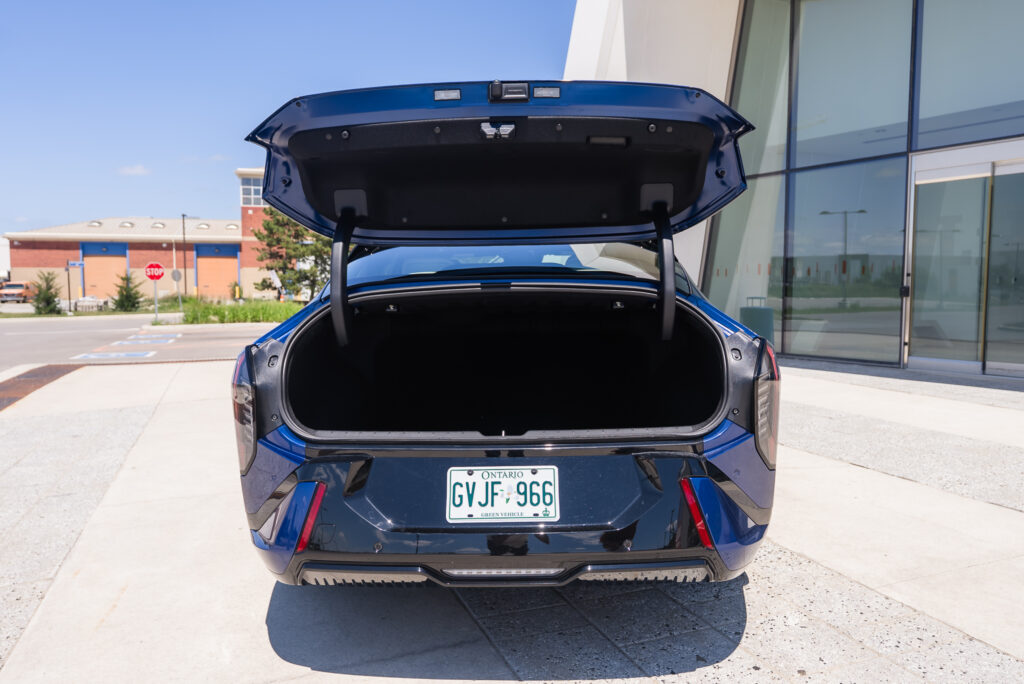
Some people have smaller garages or parking spaces. Some prefer the handling and efficiency of a sedan. Some simply don’t need to haul a Labrador retriever, three hockey bags and half the contents of Costco everywhere they go.
For those buyers, the EV4 deserves considerably more attention than it’s currently receiving.
In fact, I think Kia might need to sweeten the EV4 deal slightly. Create enough daylight between the EV4 and EV5 and give consumers a financial reason to rediscover the sedan.
Get them into the driver’s seat and the EV4 can do the rest.
The Lease Rates Aren’t Helping
Here’s another part of the equation.
Courtesy of LeaseBusters and CarCostCanada, current EV4 lease rates aren’t exactly screaming “take me home.”
Rates start around 5.49% for 36 months and rise to approximately 6.49% for 60 months. Financing is somewhat more attractive at approximately 3.99% through 60 months, 4.99% through 72 months and 5.99% if you’re brave enough to sign one of those 96-month “I’ll eventually own this thing” contracts.
A 60-month lease lands in the neighbourhood of $580 plus tax per month with no down payment, depending on configuration and program specifics.
At stronger subvented lease rates, I think Kia could make the EV4 substantially more compelling.
The Sedan Isn’t Dead Yet
Here’s where I ultimately landed.
I like the 2026 Kia EV4.
Quite a lot, actually.
It’s attractive without looking bizarre, quick without pretending to be a sports car, quiet, comfortable, technologically impressive and remarkably affordable when the federal incentive enters the equation.
And 488 kilometres of range in the GT-Line means this isn’t merely an urban commuter that needs an extension cord every time you leave town.
The biggest obstacle facing the EV4 may not be the EV4 at all.
It’s the EV5 sitting across the showroom.
Canadians love crossovers, and Kia has priced its electric crossover close enough to the EV4 that many buyers may automatically migrate toward the bigger vehicle.
But before you do, drive the EV4.
In fact, if you’re currently shopping for a Civic, Corolla, Mazda3, Elantra, Sentra or K4, I’d suggest doing something you probably weren’t planning to do:
Go drive an electric Kia.
You may be pleasantly surprised.
I certainly was.
James Matthews is the President, General Manager and Co-Founder of LeaseBusters. James launched LeaseBusters in 1990 and is considered one of Canada’s leading experts on new-vehicle leases, lease takeovers, and vehicle lease (re)marketing. James can be reached directly at jmatthews at leasebusters.com