

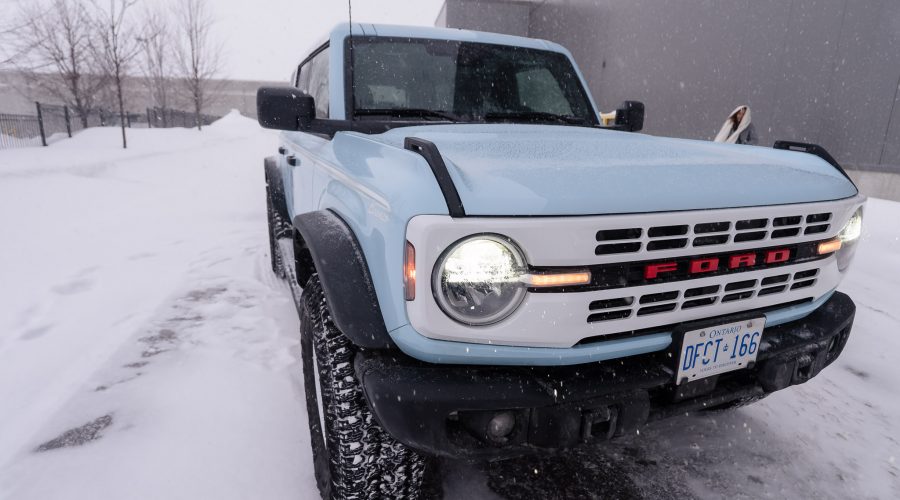
If there’s one thing Ford has proven over the last few years, it’s that nostalgia sells — especially when you wrap it in modern tech, real capability, and just enough attitude to make Jeep glance nervously over its shoulder. Enter the 2026 Ford Bronco Heritage Edition AWD, a vehicle that has slowly but surely won me over.
I’ll be honest. When Ford first announced the rebirth of the Bronco, I was skeptical. Another retro resurrection? Been there, done that. I also remember the later full-size Broncos — the big, honkin’ two-doors from the late ’70s that sat on the F-Series platform and took up most of the driveway. In my mind, that’s what a Bronco was supposed to look like. But then I did some homework.
The original Bronco actually debuted in the 1966 model year as a compact two-door SUV and stayed largely unchanged until 1977. Those early Broncos were tidy, purposeful, and — as it turns out — very cool. So cool, in fact, that pristine examples now routinely trade hands for well north of $100,000. If you’ve watched Shrinking on Apple TV, you’ll spot Jason Segel’s character cruising around in a 1969 or 1970 Bronco. That truck alone could convince anyone that explains the current Bronco obsession.
Here’s a fun stat that really puts things in perspective: today’s Bronco two-door is almost two feet longer than the original. Progress, packaging, and cupholders will do that. The modern Bronco arrived for the 2021 model year in both two- and four-door configurations, and Canadians responded almost immediately. Ford has been selling roughly 10,000 to 12,000 Broncos annually in Canada (excluding the Bronco Sport, which shares little more than the badge), while the Jeep Wrangler — its long-time archrival — sold just under 13,000 units. That’s impressive traction for a vehicle that’s only five model years into its comeback tour.
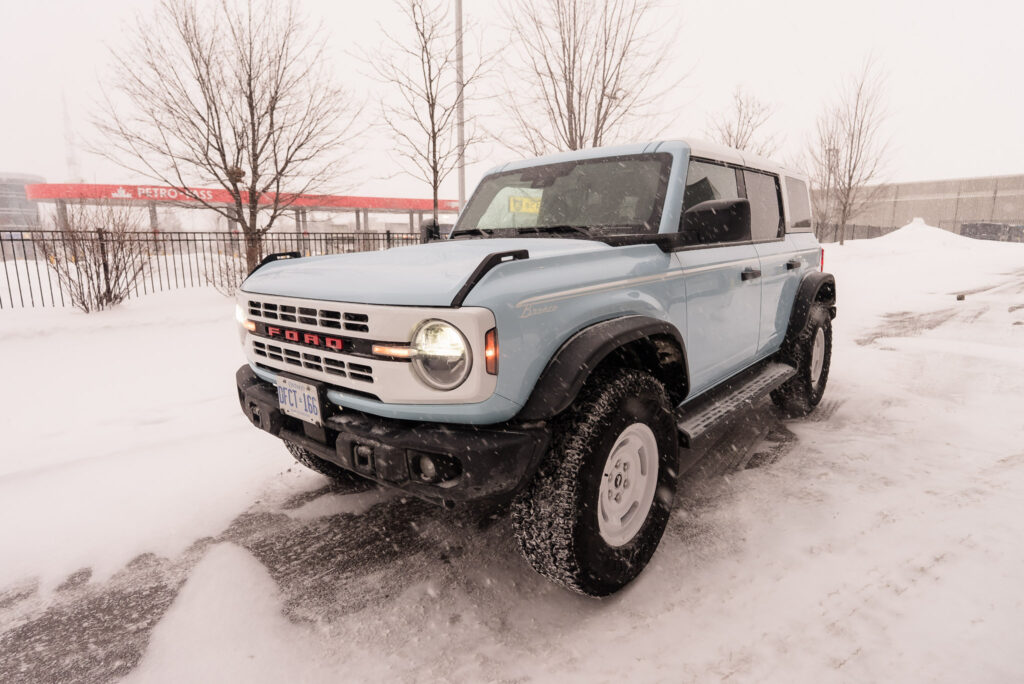
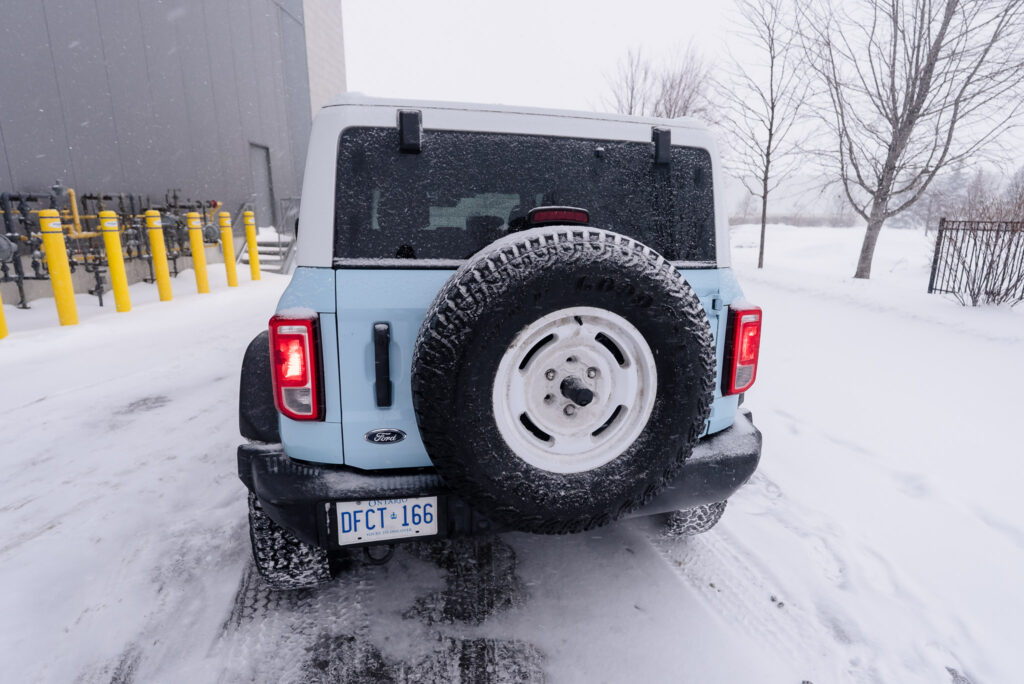
Now let’s talk Heritage Edition — the trim that leans hardest into the original Bronco’s DNA. If you squint just a little, you’ll see strong visual callbacks to the first-generation truck: the boxy proportions, the upright stance, the white-painted grille with bold “BRONCO” lettering, the retro-inspired wheels, and the contrasting roof that screams 1960s optimism. It’s nostalgia done right, without feeling costume-y.
The Heritage Edition occupies a very interesting spot in the Bronco lineup. It’s a true mid-level trim that can be optioned from the low $70,000 range into the high $70,000s, depending on drivetrain and equipment. The Bronco Heritage I road-tested was powered by Ford’s 2.7L twin-turbo V6 paired with a 10-speed automatic transmission. Sticker price? $76,625.
That’s real money. And yes, I’m fully aware that for roughly $3,000 more you can step into a Lincoln Nautilus — which is unquestionably more refined, more luxurious, and arguably “more truck” in the traditional sense. Yet more people are lining up for the Bronco Heritage. Why? Because the Bronco has something the Nautilus doesn’t: personality. It feels like a lifestyle choice rather than a sensible purchase. And Canadians are clearly buying into that.
According to my colleagues at LeaseBusters, a 2026 Bronco Heritage Edition AWD four-door with the V6 and automatic transmission leases for approximately $926 plus tax per month over 48 months. Ford Credit doesn’t currently offer a 60-month lease on the Bronco, which tells you everything you need to know about confidence in residual values. Financing the same truck over 84 months comes in around $1,047 per month — not far off the tax-in lease payment but stretched over three additional years. Food for thought.
If you’re looking to shave a few dollars off, the base 2.3L turbocharged four-cylinder with the seven-speed automatic leases for about $50 less per month. And truthfully, the 2.3L is more than powerful enough for most Bronco buyers. It’s responsive, refined, and doesn’t feel overworked.
According to the data folks at CarCostCanada, the 2026 Bronco lineup offers nine distinct styles, starting with the two-door Base at $51,500 and topping out with the four-door Bronco Raptor at a wallet-stretching $110,000. Ford is clearly not afraid to wander into luxury-tax territory — and judging by sales, buyers are perfectly comfortable following them there.
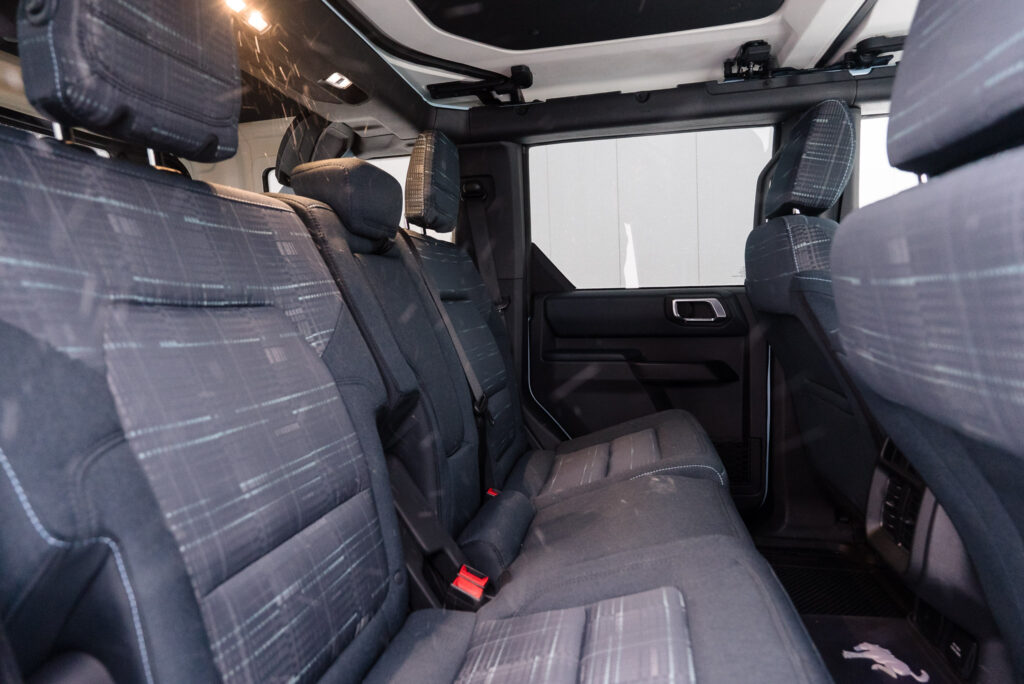
Beyond the styling, the Heritage Edition shines in how it blends retro charm with modern usability. You get Ford’s GOAT drive modes — which, in Ford-speak, stands for “Go Over Any Terrain,” not “Greatest Of All Time,” although Bronco fans may argue both apply. These selectable modes adjust throttle response, transmission behavior, traction control, and drivetrain settings to suit everything from daily commuting to sand, mud, snow, and rock crawling.
On the road, the Bronco is surprisingly civilized. The suspension is excellent, soaking up rough pavement without feeling floaty or unsettled at highway speeds. In fact, it’s significantly more composed than the Jeep Wrangler when cruising at speed. It doesn’t get bullied by crosswinds, and it tracks confidently — something Wrangler owners will appreciate but may not want to admit.
The steering is light but accurate, and despite its boxy shape and off-road chops, the Bronco feels nimble around town. It’s easy to place, easy to park, and never feels cumbersome. The ride quality strikes a smart balance between comfort and capability.
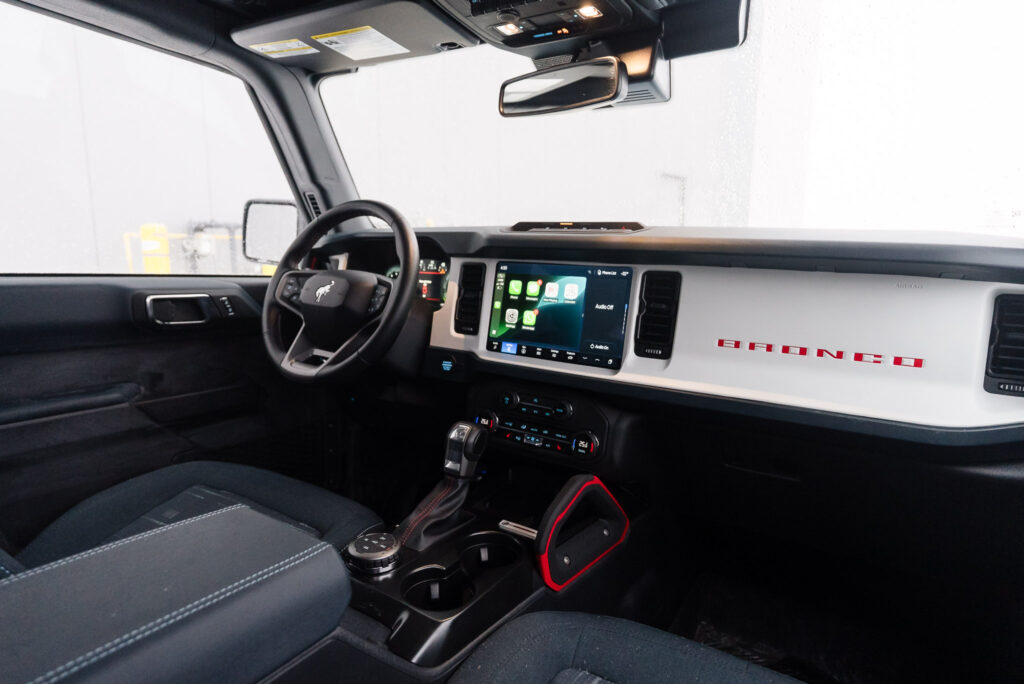
Inside, the Bronco delivers plenty of tech without overwhelming the driver. The infotainment system is intuitive, responsive, and easy to use — even with gloves on. Digital displays are crisp, the camera systems are genuinely useful when navigating tight trails or parking garages, and the available driver-assist technologies add a welcome layer of confidence for daily driving.
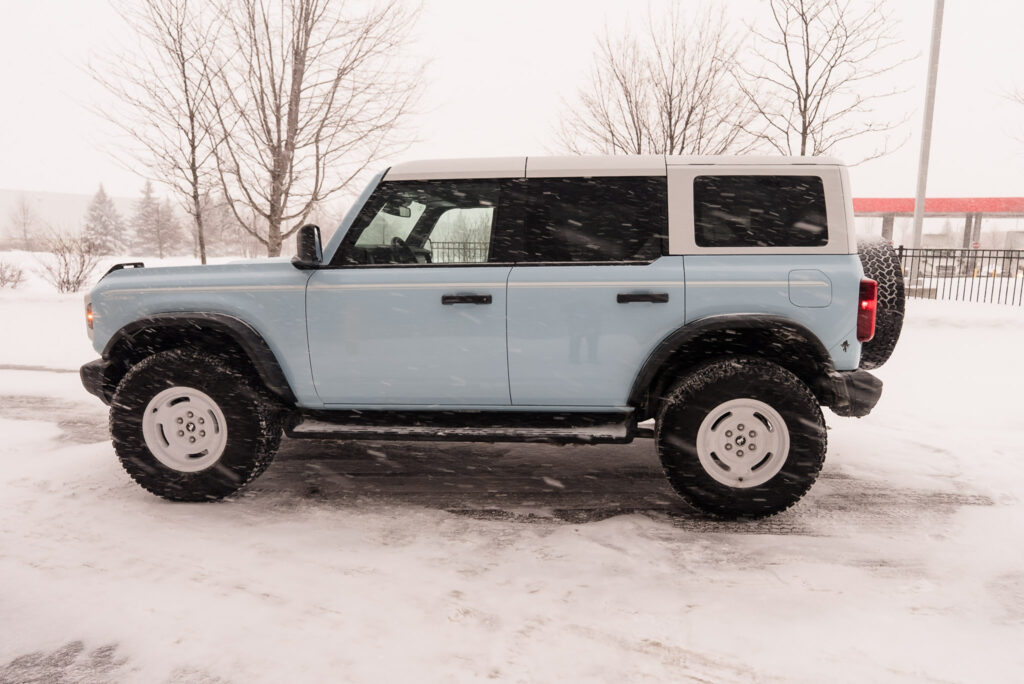
And then there are the fun bits. Removable roof panels. Removable doors. Exposed bolts and grab handles that invite adventure. This is a vehicle that actively encourages you to use it, not just admire it from afar.
In the broader competitive landscape, the Bronco sits among some serious players. Aside from the Jeep Wrangler, it squares off against the Toyota Land Cruiser starting at $71,555, the Toyota 4Runner at $55,270, the Land Rover Defender at $75,700, and the Lexus GX at $87,140. That’s premium company — and the Bronco belongs there.
If I had one critique of the Heritage Edition, it’s this: Ford should have offered it in a two-door configuration. A two-door Heritage would have been the closest thing yet to the original Bronco, and it would have looked absolutely fantastic. That said, I also understand reality. Most buyers want four doors. Families, friends, dogs, gear — life happens. Ford made the practical call.
At the end of the day, the Bronco Heritage Edition works because it delivers on emotion and execution. It’s comfortable, capable, good-looking, and genuinely enjoyable to drive. People like them. People want them. And that’s exactly why they’re buying and leasing them.
If you’re shopping for one, do yourself a favour and check pricing and incentives through CarCostCanada, and if leasing is on your radar, LeaseBusters remains the go-to resource for understanding real-world payments and exit strategies. The Bronco may be a throwback at heart, but the way Canadians are buying them is very much a sign of the times.
James Matthews is the President, General Manager and Co-Founder of LeaseBusters. James launched LeaseBusters in 1990 and is considered one of Canada’s leading experts on new vehicle leases, lease-take-overs and vehicle lease (re)marketing. James can be reached directly at jmatthews at leasebusters.com