

Every once in a while, a vehicle shows up in my driveway that makes me pause, raise an eyebrow, and say, “Really? This is how much it costs now?”
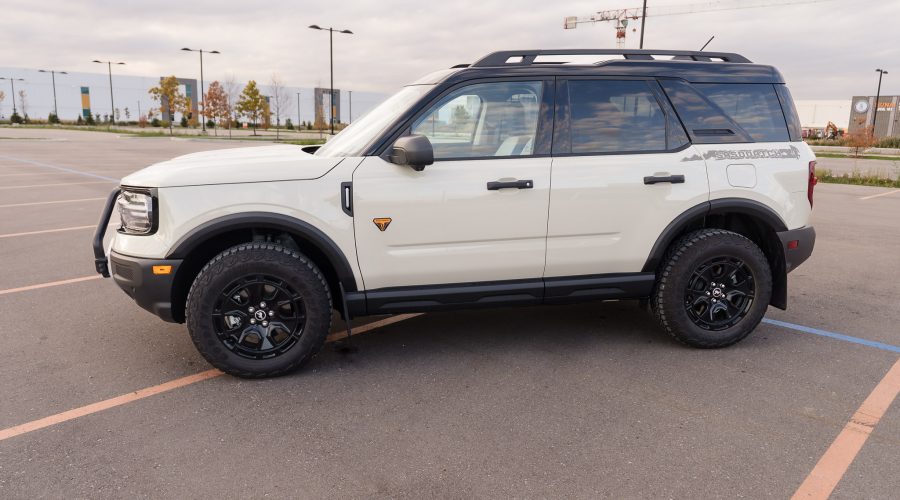
That was my first reaction when I stepped into the 2025 Ford Bronco Sport Badlands with the Sasquatch Package. Price as tested: $59,215. Yes… for the Bronco Sport, not the full-size Bronco you see conquering boulders on Instagram. But before you close your browser, hear me out — because I think Ford is playing a very interesting game with this vehicle, and they might know something the rest of the industry hasn’t figured out yet.
Sasquatch: More Than Just a Sticker (Thankfully)
Let’s get this out of the way. The Sasquatch package is not just a badge and a pep talk. Ford actually equips the Badlands with legitimate off-road kit: upgraded suspension, off-road dampers, steel bumpers, recovery hooks, underbody protection, chunkier tires, and a general “let’s go get muddy” attitude.
In other words, if you actually want a Bronco Sport that can behave like a mini-Bronco, this is the one that makes it happen.
A Big Price for a “Little Bronco”
Now, courtesy of CarCostCanada.com, the regular Bronco Sport lineup is priced far more reasonably:
- Big Bend 4×4 – $38,795
- Free Wheeling 4×4 – $42,595
- Heritage 4×4 – $42,795
- Outer Banks 4×4 – $43,495
- Badlands 4×4 – $49,295
These numbers make sense — until you pile on the Sasquatch gear and start inching closer to $60K. At that price, you’re knocking elbows with bigger SUVs, nicer interiors, and even some luxury-leaning trims from other brands.
But the biggest eyebrow-raiser isn’t the price. It’s the engine strategy.
Why Are We Still Getting the 3-Cylinder?
Every Bronco Sport except the Badlands gets the 1.5L Ecoboost 3-cylinder. Yes, it has 180 horsepower, and yes, it actually pulls reasonably well for a “three-banger,” but it’s not exactly a fuel-saving miracle.
The Badlands, however, gets what the Bronco Sport should have had from Day One: the 2.0L Ecoboost 4-cyl with 250 horsepower, which transforms the vehicle into something you actually enjoy pushing onto a highway ramp.
And here’s the head-scratcher:
Why doesn’t Ford drop the 2.5L Hybrid (from the Maverick) into the Bronco Sport?
It would offer far better fuel economy, more low-end torque, and instant buyer appeal. My theory? Ford can’t build enough hybrid drivetrains to satisfy Maverick demand, let alone another model. And maybe Ford believes — correctly — that Bronco Sport buyers value toughness over efficiency.
But I still think the hybrid would be a home run. And I still think Ford knows this. Which leads me to my bigger theory…
What Ford Might Know That the Rest of Us Don’t
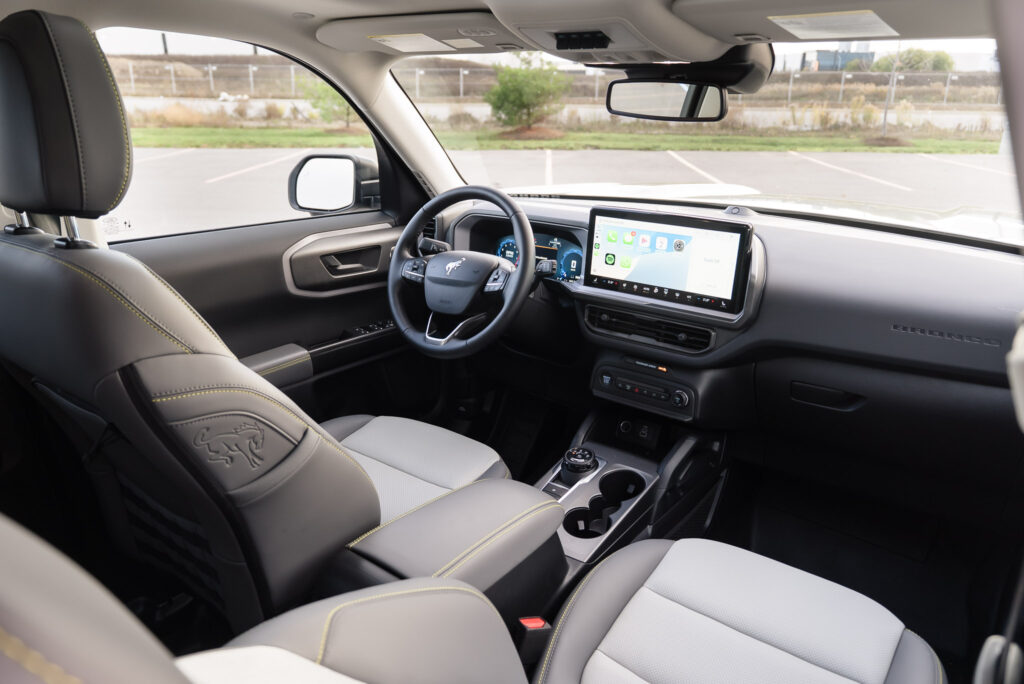
I believe Ford has identified a niche inside the compact SUV segment that absolutely no one was catering to — a niche of buyers who want:
- The look of adventure
- The feel of driving something tougher than a regular crossover
- The image of “I can go off-road if I want to, even if I never actually do”
- The compact size and daily practicality of an Escape
- And a driving position that sits more like a mini truck than a small SUV
This is the same secret sauce that made the Ford Maverick explode in popularity: something small, affordable-ish, and extremely identity-driven.
All other OEMs are busy trying to beat each other with features, fuel economy, and “premium-ness” in the compact SUV category. Ford walked in and said:
“Let’s build the only rugged, adventure-first compact crossover in the entire segment.”
Jeep Compass tried. Subaru Crosstrek Wilderness sort of tried. Mazda CX-50 is not even close. But none have the instant brand recognition or social cachet that the Bronco badge carries.
Ford saw that empty lane. And they took it. Completely.
GOAT Modes and the “Mini-Truck Feeling”
This brings us to two of the Bronco Sport’s magic ingredients.
- GOAT Modes (“Goes Over Any Terrain”)
Even if you never plan on rock-crawling your way to the top of Banff, there is something undeniably fun about toggling through Normal, Eco, Slippery, Mud/Ruts, Sand, and Rock Crawl modes.
It’s the closest thing to ordering a “personality change” from your vehicle.
And it’s what makes the Bronco Sport feel like something more than the sum of its parts.
- The Driving Position
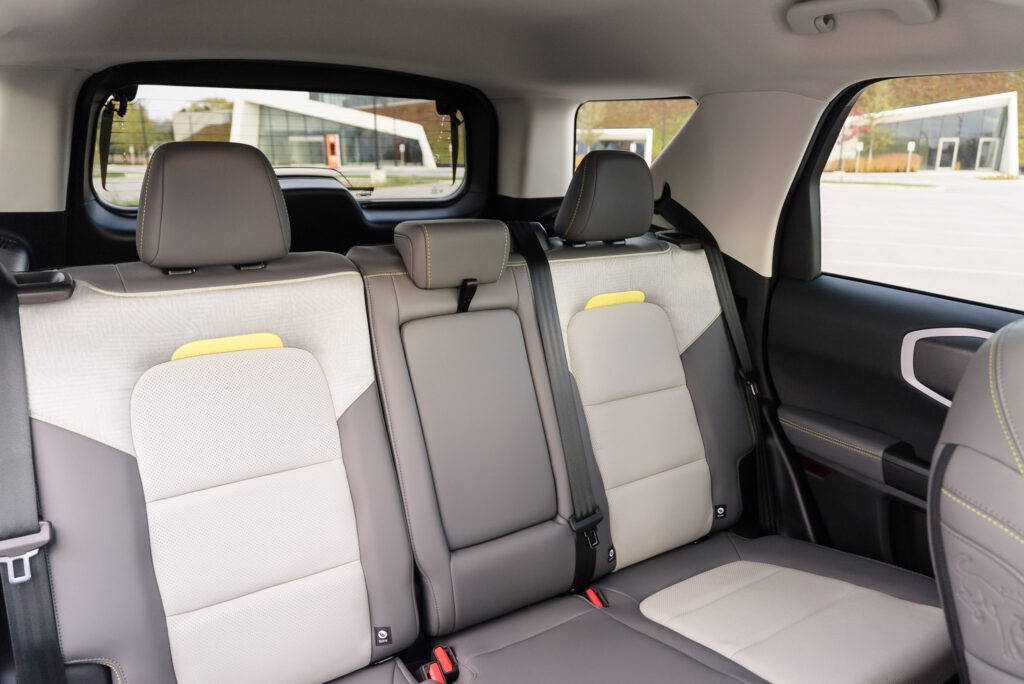
When I slid behind the wheel, I noticed — immediately — that I was sitting significantly higher than in other compact SUVs. The seat doesn’t drop as low as most crossovers. I actually felt like I was in a smaller F-150 rather than an Escape cousin.
It gives the Bronco Sport a sense of presence that its direct competitors simply do not have.
Interior Tech & Road Manners
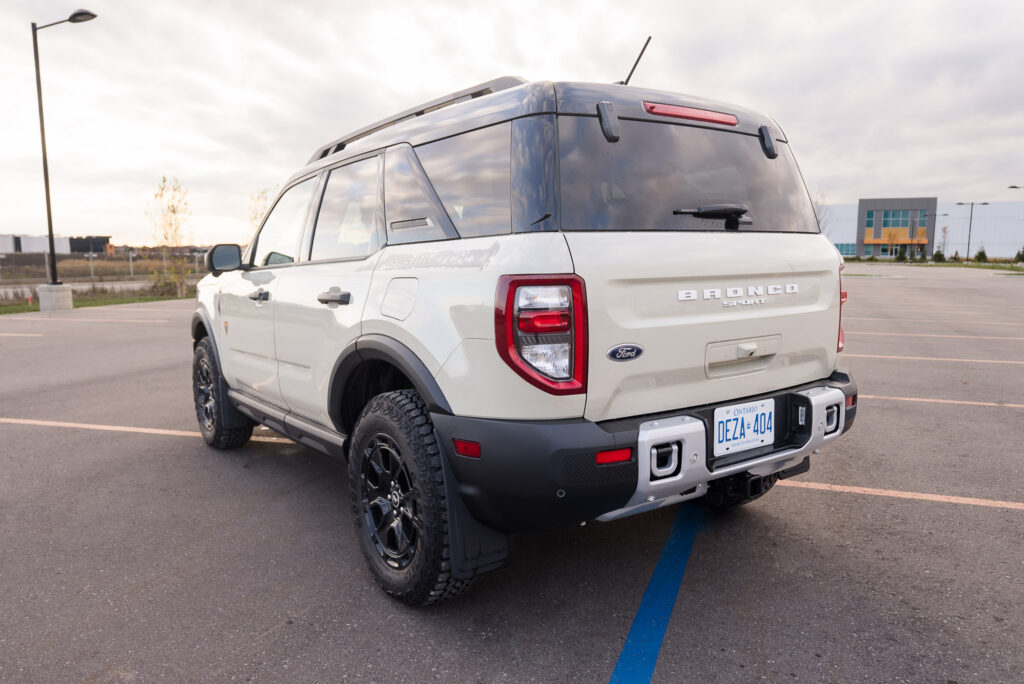
Inside, Ford gives you a clean, modern interface. The big touchscreen, the intuitive layout, and the simplicity of the menus work well whether you’re commuting or heading out of town.
On the road, the 2.0L Badlands I tested had more than enough power. Highway merging was easy, passing was effortless, and the suspension — even with its off-road bias — kept the vehicle tracking straight and confidently.
This is not a “soft and mellow” compact SUV.
It’s firmer, more deliberate, almost truck-like.
And that’s entirely the point.
So, Who Should Buy the 2025 Bronco Sport?
Perfect for you if:
- You want something different in a sea of crossovers
- You love the outdoors, even if your definition of “outdoors” is a gravel parking lot at a cottage resort
- You enjoy sitting high and feeling like you’re in a tough little truck
- You appreciate the Bronco identity
- You’ll actually use (or at least appreciate) the off-road capabilities
Maybe not for you if:
- You want maximum fuel economy
- You want luxurious interior materials
- You’re price-sensitive
- You won’t use any of the rugged features
At the end of the day…..
The 2025 Bronco Sport Badlands Sasquatch is one of the coolest, most personality-driven compact SUVs on the market. It’s fun, it’s different, it’s capable, and it fills a market gap that no other manufacturer even bothered to look for.
Is it expensive? Yes.
Is it worth it?
Depends on whether you want a crossover — or a crossover with a persona.
Ford clearly believes that persona has value.
And judging by the number of Bronco Sports I see on the road…
They might be onto something.
James Matthews is the President, General Manager and Co-Founder of LeaseBusters. James launched LeaseBusters in 1990 and is considered one of Canada’s leading experts on new vehicle leases, lease-take-overs and vehicle lease (re)marketing. James can be reached directly at jmatthews at leasebusters.com