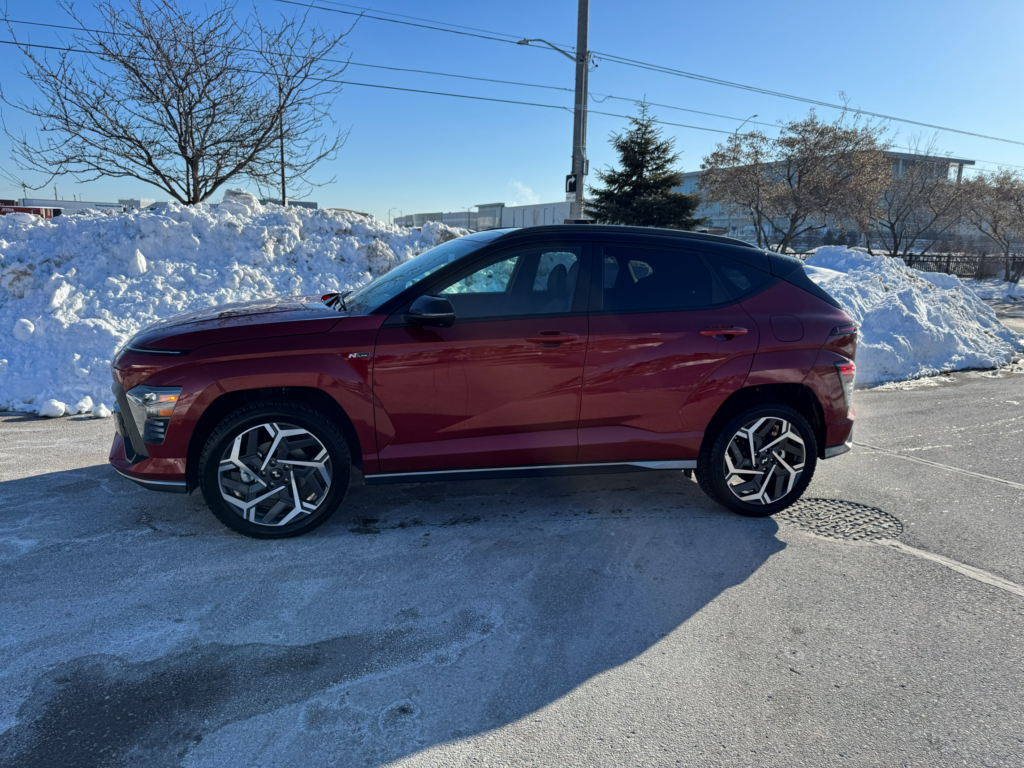
Chantale and I bundled up (again) and headed out for another winter test drive, this time in the 2026 Hyundai Kona N-Line AWD — a sporty compact “SUV” that, technically speaking, is a CUV. For clarity: a traditional SUV is typically built on a truck-based body-on-frame platform (think rugged, tow-happy bruiser), whereas a CUV (crossover utility vehicle) rides on a car-based unibody platform, which usually means better ride comfort, handling and fuel efficiency. But since the world calls them SUVs — and CUV sounds like a vitamin deficiency — we’ll stick with SUV.
Now, you might assume that in a world where every automaker sells approximately 47 different SUV models, they’d all start to blend together like beige paint samples. The Kona clearly didn’t get that memo.
Before diving deep into the N-Line, I did what any payment-conscious, spreadsheet-loving reviewer would do — I popped over to CarCostCanada to check trims and pricing. They list nine model styles, though in reality it’s seven because Hyundai counts two-tone roof versions as separate “models” even though they cost the same. (Marketing departments need hobbies too.)

The range starts at $26,749 for the 2.0L Essential FWD and tops out at $39,399 for the 1.6T N-Line Ultimate AWD. Hyundai Canada charges a tidy $2,000 to upgrade from FWD to AWD, and there’s a $12,650 spread from base to top trim.
So, what exactly separates the entry-level Essential from the N-Line Ultimate AWD?
Quite a lot, actually.
The base 2.0L Essential FWD gives you the fundamentals: a naturally aspirated 2.0L engine, basic infotainment with touchscreen display, wireless Apple CarPlay/Android Auto, cloth seats, standard safety tech including forward collision avoidance and lane keeping assist, and heated front seats (because Canada).
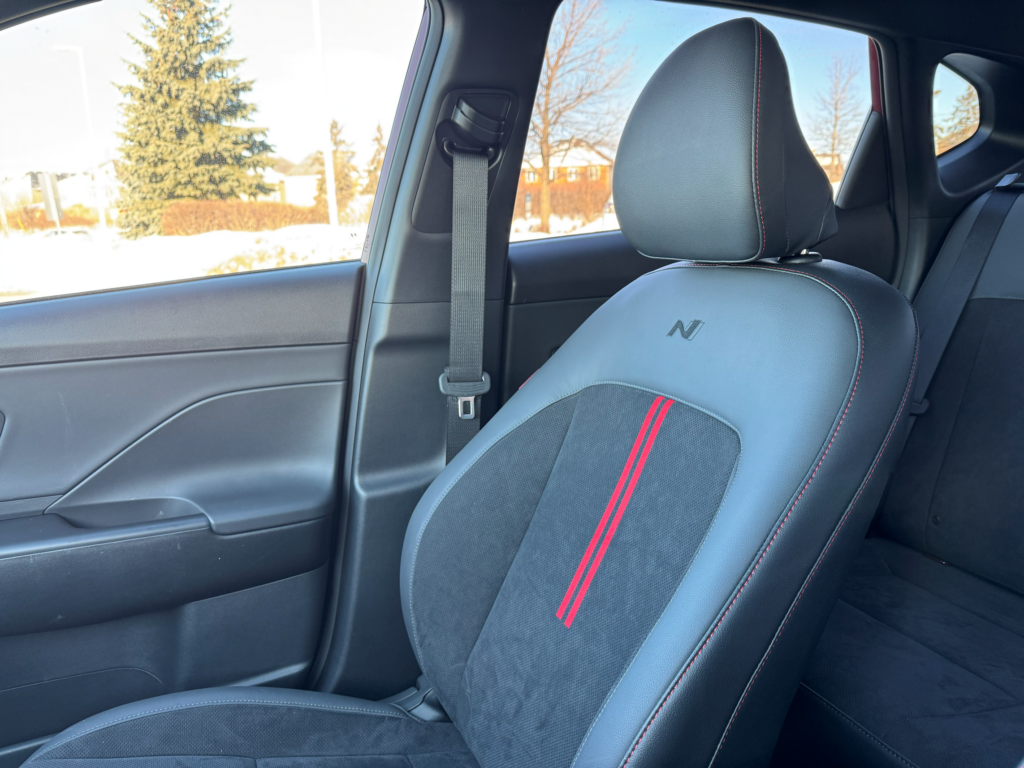
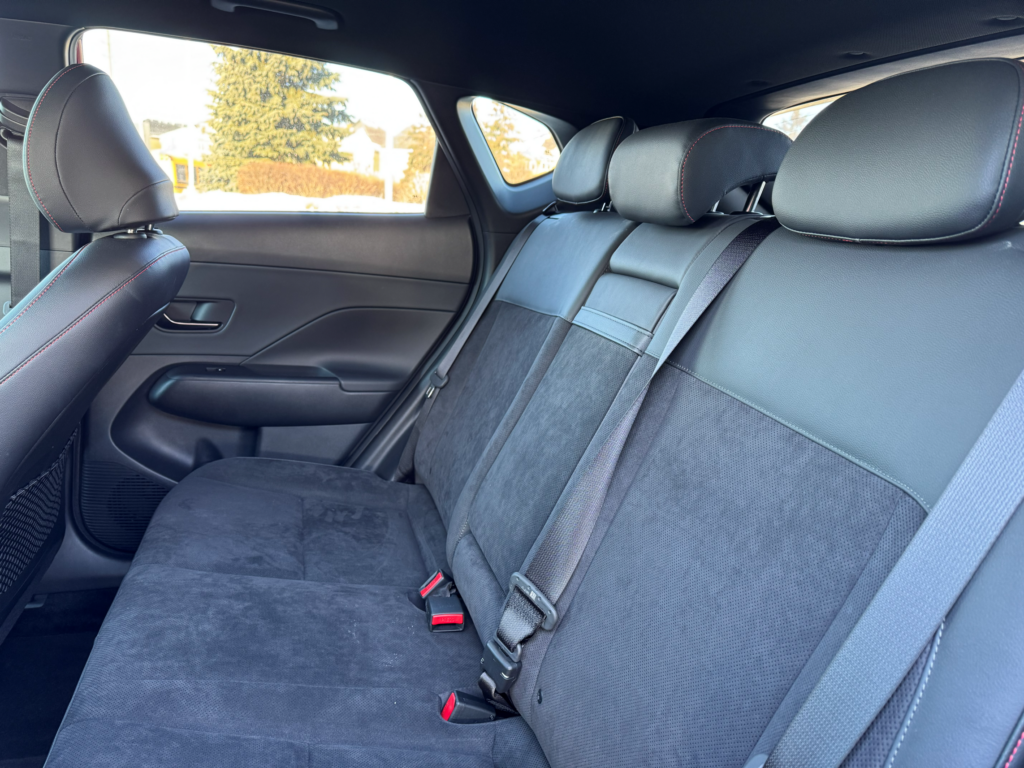
Step into the N-Line Ultimate AWD and things escalate quickly. You get the 1.6L turbocharged engine producing 190 horsepower paired with an 8-speed automatic transmission, standard AWD, larger alloy wheels, upgraded sport-tuned suspension, N-Line exterior styling accents, LED lighting upgrades, a larger dual-screen digital display setup, built-in navigation, Bose premium audio, leather and suede sport seats, power driver’s seat with memory, heated rear seats, ventilated front seats, head-up display, surround-view monitor, smart cruise control with advanced highway assist and a full suite of enhanced driver-assistance features.
In short: the Essential is sensible footwear. The N-Line Ultimate is Italian loafers with red stitching.
Let’s talk about that powertrain.
The 1.6L turbo four-cylinder is quiet when you want it to be and lively when you don’t. At 190 horsepower, it doesn’t sound outrageous on paper, but in this compact SUV, it feels genuinely eager. Merging onto the highway was drama-free, highway passing required minimal planning, and on city streets the Kona felt nimble and responsive. The 8-speed automatic is smooth and well-matched, never hunting for gears or reminding you that it exists — which is exactly what a transmission should do.
The suspension deserves its own paragraph. It’s firm enough to remind you this is an N-Line but not punishing. Over winter-ravaged pavement, the Kona absorbed imperfections with composure. On ramps and sweeping highway curves, it felt planted and confident. More than once I commented to Chantale that it felt like I was driving something larger — not in a bloated way, but in a substantial, secure way.
And then there’s the interior.
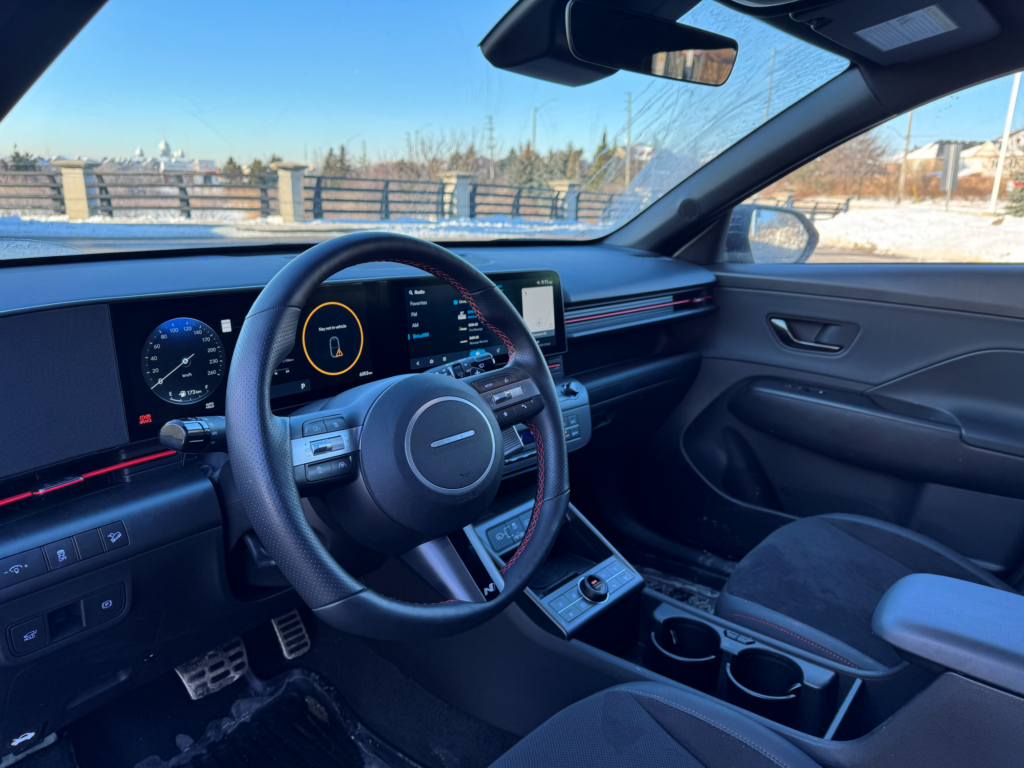
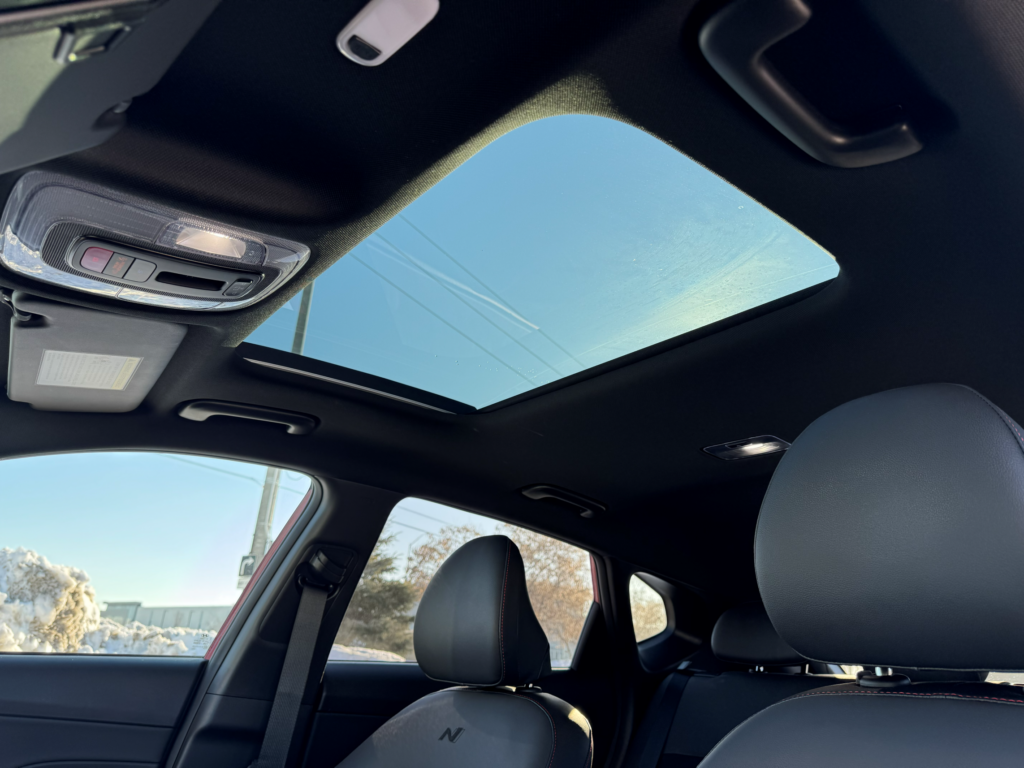
Hyundai’s user interface is one of the best in the business right now. The dual-screen layout is clean, modern and intuitive. The graphics are crisp, menus are logically structured, and — brace yourself — there are still actual buttons and knobs for climate and audio. No archaeological expedition is required to adjust the temperature. The learning curve is practically flat. Within minutes, everything feels second nature.
Optically, the dash layout and screen integration create a sense of width that psychologically makes the Kona feel like it belongs a class above. It’s clever design, and it works.
The leather-and-suede seat combination adds a genuinely sporty vibe. It feels upscale, supportive, and appropriate for a vehicle nudging past $40,000 once freight, air tax, and sales tax are factored in. Because yes — with taxes in markets like the Greater Toronto Area, you’re cresting that psychological $40K hill.
Which brings us to the price conversation.
Hyundai, like many Asian automakers, bundles features into trims rather than offering endless option sheets. On one hand, it simplifies ordering. On the other, it forces you to climb the trim ladder to get certain must-haves. That $12,650 delta from base to N-Line Ultimate isn’t pocket change.
But here’s where perspective matters.
A brand-new 2026 Kona 2.0L Essential FWD leases for approximately $343 plus tax per month over 60 months on a standard Hyundai Financial program with minimal upfront costs beyond fees and first payment. Finance it over 84 months and you’re around $412 per month (pre-tax). Those are approachable numbers for many households.
The N-Line Ultimate AWD? Over 84 months, you’re looking at payments that stretch accordingly — 60 month lease for $517 + taxes and an 84 month loan for $592/month. On paper, that sounds long. In reality, many Canadians keep vehicles that long anyway.
And compared to other fully loaded competitors in the segment — think similarly equipped models from Toyota, Honda or Mazda — the Kona N-Line Ultimate AWD holds its ground surprisingly well in value, especially when you factor in its performance and tech content.
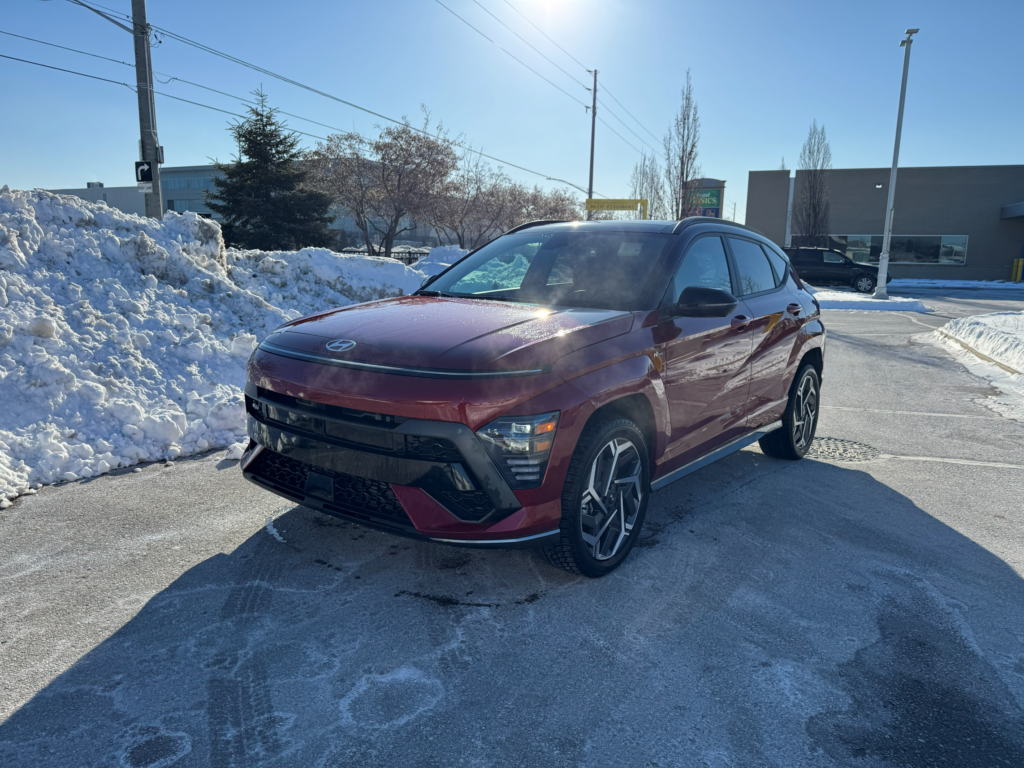
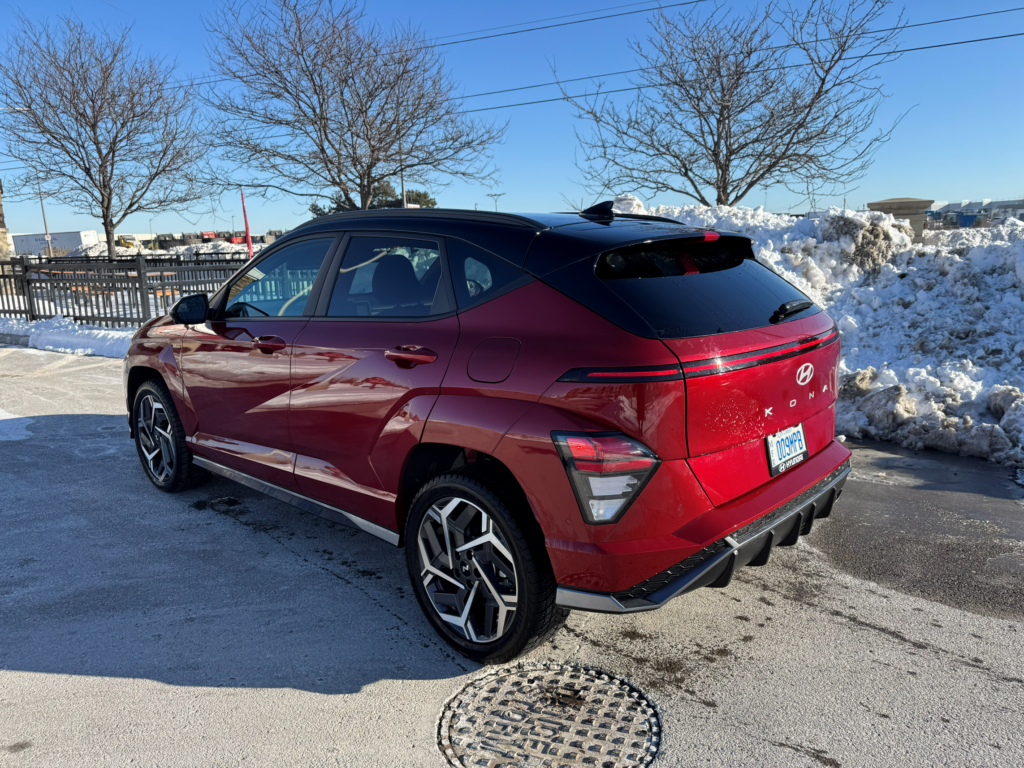
The design itself deserves credit. The Kona doesn’t blend in. Its lighting signature, angular body lines and assertive front fascia give it personality in a segment that often feels like it was designed by committee. It’s distinct without being polarizing — a tricky balance.
So why would someone pay the extra $12,650?
Because they don’t just want transportation. They want engagement. They want tech that feels modern. They want a little turbocharged swagger on their morning commute. They want to open the door and feel like they treated themselves.
The base Kona is rational. The N-Line Ultimate AWD is emotional.
After a week of winter driving, highway merging, grocery runs and more than one “let’s take the long way home” detour, I can confidently say the Kona N-Line AWD surprised me. It felt bigger than it is, more refined than expected and more fun than a practical compact SUV has any right to be.
Would I personally wrestle with that $12,650 upgrade gap? Absolutely. But that’s the point. The Kona makes the decision interesting.
And in a market overflowing with SUVs that all start to feel the same, being interesting is half the battle won.
James Matthews is the President, General Manager and Co-Founder of LeaseBusters. James launched LeaseBusters in 1990 and is considered one of Canada’s leading experts on new vehicle leases, lease-take-overs and vehicle lease (re)marketing. James can be reached directly at jmatthews at leasebusters.com